
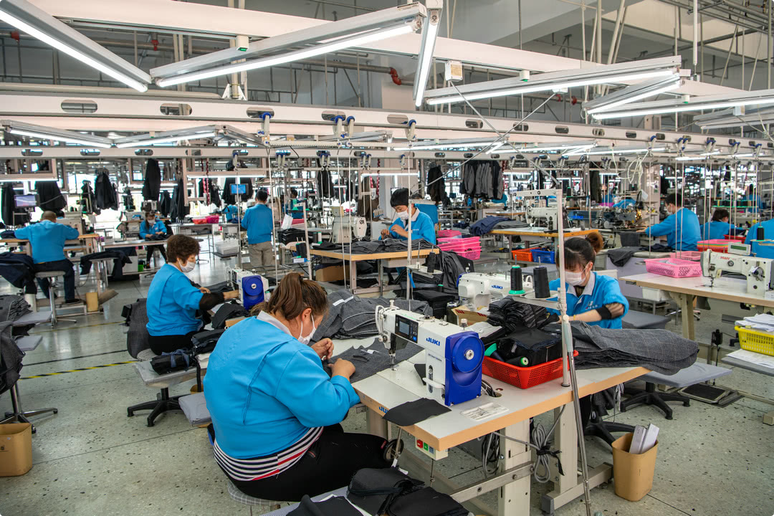
China’s apparel industry is currently navigating a major structural transformation. Long recognized as the undisputed "World's Factory" for textiles and garments, the sector is transitioning from a high-volume manufacturing powerhouse into an automated, data-driven, and culturally rich brand and tech leader.
For international procurement teams, brand managers, and sourcing strategists, understanding this ongoing shift is critical. China remains the largest apparel producer and market in the world, but the value proposition has changed: sourcing from China today is less about finding cheap labor and more about leveraging flexible supply chains, AI-driven speed, high-performance textiles, and advanced automation.
1. Industry Scale and Market Dynamics
Despite global trade uncertainties and shifting supply chain routes, China’s apparel industry maintains unrivaled operational scale and deep ecosystem integration.
Key Market Observations for Global Buyers
- Domestic Market as the Industry Anchor: Domestic sales of garments, footwear, and textiles reached over ¥1.1 trillion RMB, growing 2.8% year-over-year. This massive internal demand allows factories to remain solvent and invest heavily in technology even during global export dips.
- Export Landscape Under Re-adjustment: Apparel export value stood at $151.18 billion USD (a 5.0% YoY decline). While traditional demand from Europe, the US, and ASEAN experienced fluctuations, exports to emerging markets in Latin America and Africa showed strong growth resilience.
- From Volume to Value: China produces over 35 billion garments annually. Rather than expanding physical volume, Chinese apparel leaders are upgrading unit value, product functionality, and production speed.
2. Regional Clusters and The "Gradient" Manufacturing Model
- China’s apparel manufacturing is geographically structured in a tiered or "gradient" model, offering international buyers distinct sourcing hubs depending on order volume, lead times, and technical complexity.
- Eastern Coastal Hubs (Zhejiang, Jiangsu, Shandong, Guangdong): These provinces remain the primary sourcing centers for international brands. They house fully integrated supply chains—from raw fiber production and digital dyeing to automated assembly and direct port logistics.
- Central & Western Expansion (Hubei, Guangxi, etc.): Supported by upgraded infrastructure and inland transport networks, central provinces are absorbing large-scale basic garment manufacturing, helping companies optimize labor costs while keeping the overall supply chain within China.
3. Technology & AI Integration: From Experience to Data-Driven Production
To combat rising wage costs and shortened product lifecycles, Chinese apparel manufacturers are replacing traditional "experience-driven" methods with "data-driven" smart manufacturing.
AIGC in Design and Prototyping
Artificial Intelligence is transforming how collections are developed:
- Generative Design: Designers use AI tools to generate hundreds of print patterns and silhouette variations in minutes.
- 3D Virtual Sampling: Brands can evaluate virtual garments online, drastically reducing physical sample iterations, fabric waste, and sampling time. For instance, silk pioneer Wensli (万事利) leverages AIGC to offer highly personalized, "one scarf, one pattern" mass customization.
Flexible Manufacturing and Small-Batch Production
The modern Chinese factory floor is built for agility. Integrated ERP systems link buyer orders directly to digital cutting tables and automated hanging systems, enabling small-batch, multi-variety, quick-response (QR) manufacturing. This setup empowers online brands and overseas retailers to place smaller initial orders and reorder hot items in days rather than weeks.
Predictive AI in Supply Chain Planning
AI algorithms analyze sales trends, weather data, and social media sentiment to forecast popular styles and optimize fabric stock. Some technology-enabled apparel manufacturers report sales prediction accuracy exceeding 95%, significantly minimizing overproduction risk.
High Level of Automation
According to industry benchmarks:
- 82.3% of apparel enterprises utilize digital tools for design and R&D.
- 63.7% of key manufacturing processes are controlled by numerical control (CNC) equipment or smart automation.
4. Sustainability and Functional Fabric Innovations
International compliance, ESG mandates, and shifting consumer preferences are driving rapid innovation in sustainable materials and technical performance across Chinese mills.
- Eco-Friendly Processing: Technologies like waterless digital printing and eco-friendly dyeing processes are becoming standard in coastal textile parks to comply with strict national environmental regulations.
- Functional Textiles as a Growth Driver: Technical performance features—such as anti-static treatments, UV protection, thermal control, and moisture-wicking properties—are growing rapidly. For specialized functional wear manufacturers, these technical products now account for over 50% of total sales.
- 3D Printing and On-Demand Creation: 3D printing is increasingly utilized for footwear components, specialized trims, and seamless structural apparel, laying the groundwork for true zero-waste, on-demand manufacturing.
5. Strategic Takeaways for Overseas Buyers
When sourcing garments from China today, global trade buyers should align their procurement strategies with the country's technological and structural strengths:
- Leverage Quick-Response (QR) Factories: Partner with suppliers that utilize 3D virtual sampling and flexible production lines to test new designs on low minimum order quantities (MOQs) before committing to large volumes.
- Tap into Advanced Functional Fabrics: Take advantage of China's strong position in functional and technical textiles to offer higher-margin, performance-oriented apparel lines.
- Inquire About ESG and Digital Traceability: Request details on digital printing, recycled fiber certifications (e.g., GRS), and supply chain traceability to meet international import and sustainability compliance standards.
- Explore Tiered Sourcing: Use coastal manufacturers (Zhejiang, Jiangsu, Guangdong) for high-end, fast-fashion, or technically complex items, while exploring central hubs (Hubei, Guangxi) for large-volume, cost-sensitive basic categories.